Category

Concept Art

Technical or design-focused illustrations: vehicles, devices, characters, blueprints, annotated drawings

Browse by category

Jump straight to the style of z-image prompts you need.

A digitally rendered skull composed entirely of interlocking binary code, its structure pixelated and fragmented to evoke a sense of digital decay. The skull is centered on a dark, uniform background of deep black and navy blue, with each binary segment glowing faintly in electric blue to create a striking contrast. The binary code forms the contours of the skull’s face, jawline, and collarbone, while intricate patterns of 1s and 0s weave through the ocular sockets and teeth like circuitry. The artistic style is hyper-detailed digital realism fused with futuristic abstraction, emphasizing the fusion of biological form and technological structure. The brushwork is minimal, relying on precise pixel placement to create a tactile, almost mechanical texture. Lighting is directional and ambient, casting soft highlights on the skull’s features and creating subtle shadows that define its three-dimensional form. The color palette is limited to deep blues, blacks, and a single bright electric blue for contrast, enhancing the mood of mystery and technological obsolescence. The composition is balanced and deliberate, with the skull’s symmetry broken by the chaotic yet structured nature of the binary code. The overall feeling is haunting, mysterious, and evocative of technological obsolescence where the familiar form of a skull is reimagined as a living testament to the persistence of technology against time's decay.

Binary Decay Skull

A digitally rendered skull composed entirely of interlocking binary code, its structure pixelated and fragmented to evoke a sense of digital decay. The skull is centered on a dark, uniform background of deep black and navy blue, with each binary segment glowing faintly in electric blue to create a striking contrast. The binary code forms the contours of the skull’s face, jawline, and collarbone, while intricate patterns of 1s and 0s weave through the ocular sockets and teeth like circuitry. The artistic style is hyper-detailed digital realism fused with futuristic abstraction, emphasizing the fusion of biological form and technological structure. The brushwork is minimal, relying on precise pixel placement to create a tactile, almost mechanical texture. Lighting is directional and ambient, casting soft highlights on the skull’s features and creating subtle shadows that define its three-dimensional form. The color palette is limited to deep blues, blacks, and a single bright electric blue for contrast, enhancing the mood of mystery and technological obsolescence. The composition is balanced and deliberate, with the skull’s symmetry broken by the chaotic yet structured nature of the binary code. The overall feeling is haunting, mysterious, and evocative of technological obsolescence where the familiar form of a skull is reimagined as a living testament to the persistence of technology against time's decay.
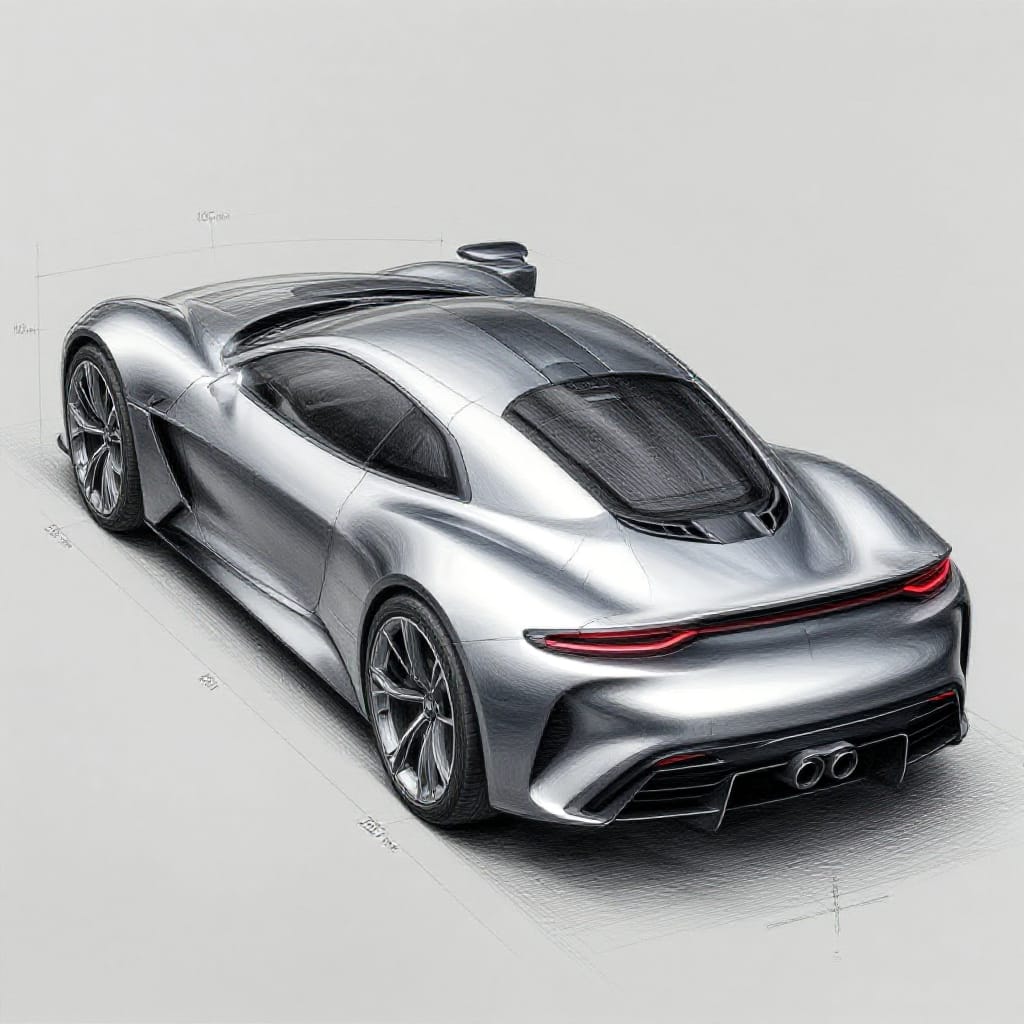
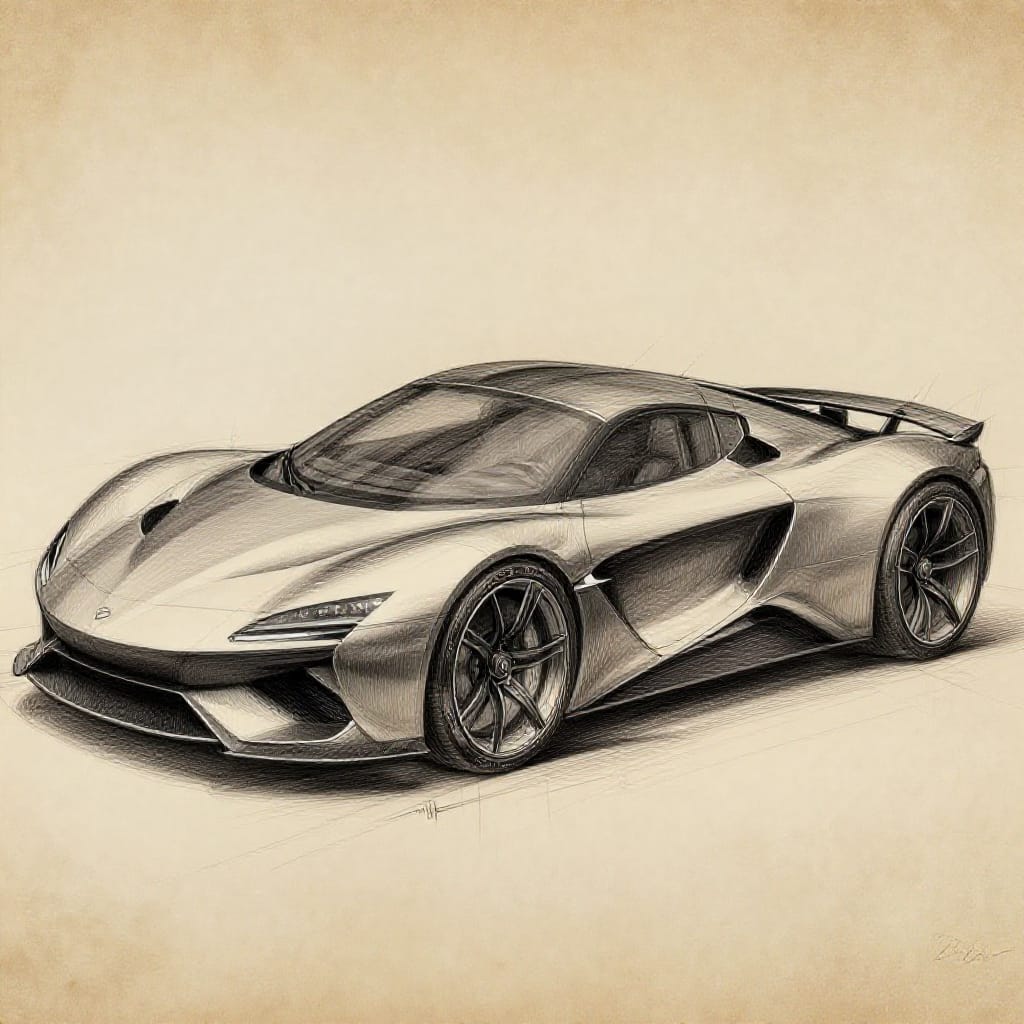
Concept art for a cutting-edge luxury sports car rendered in pencil and ink on aged paper with textured surface. The drawing features a highly detailed, scientifically accurate representation of the vehicle’s aerodynamic lines, seamless integration of aerodynamic features, and precise engineering specifications. Key technical elements include: tire size notation (20"), wheel rim width measurement (4.5"), engine displacement (5.0L), and horsepower (600). The composition balances symmetry and dynamic form, with the car positioned in profile to highlight its sleek silhouette and subtle curve across the hood. Lighting is soft and even, casting subtle cross-hatching across the chassis to emphasize depth and texture. The color palette consists of neutral grays, deep blacks, and muted browns, with fine ink lines defining every contour from the front fender to the rear spoiler. The paper’s aged texture adds organic contrast, enhancing the tactile quality of the drawing. The overall atmosphere is one of meticulous craftsmanship and analytical precision, capturing both the aesthetic beauty and technical excellence of modern automotive design.

Precision Crafted Luxury

Concept art for a cutting-edge luxury sports car rendered in pencil and ink on aged paper with textured surface. The drawing features a highly detailed, scientifically accurate representation of the vehicle’s aerodynamic lines, seamless integration of aerodynamic features, and precise engineering specifications. Key technical elements include: tire size notation (20"), wheel rim width measurement (4.5"), engine displacement (5.0L), and horsepower (600). The composition balances symmetry and dynamic form, with the car positioned in profile to highlight its sleek silhouette and subtle curve across the hood. Lighting is soft and even, casting subtle cross-hatching across the chassis to emphasize depth and texture. The color palette consists of neutral grays, deep blacks, and muted browns, with fine ink lines defining every contour from the front fender to the rear spoiler. The paper’s aged texture adds organic contrast, enhancing the tactile quality of the drawing. The overall atmosphere is one of meticulous craftsmanship and analytical precision, capturing both the aesthetic beauty and technical excellence of modern automotive design.
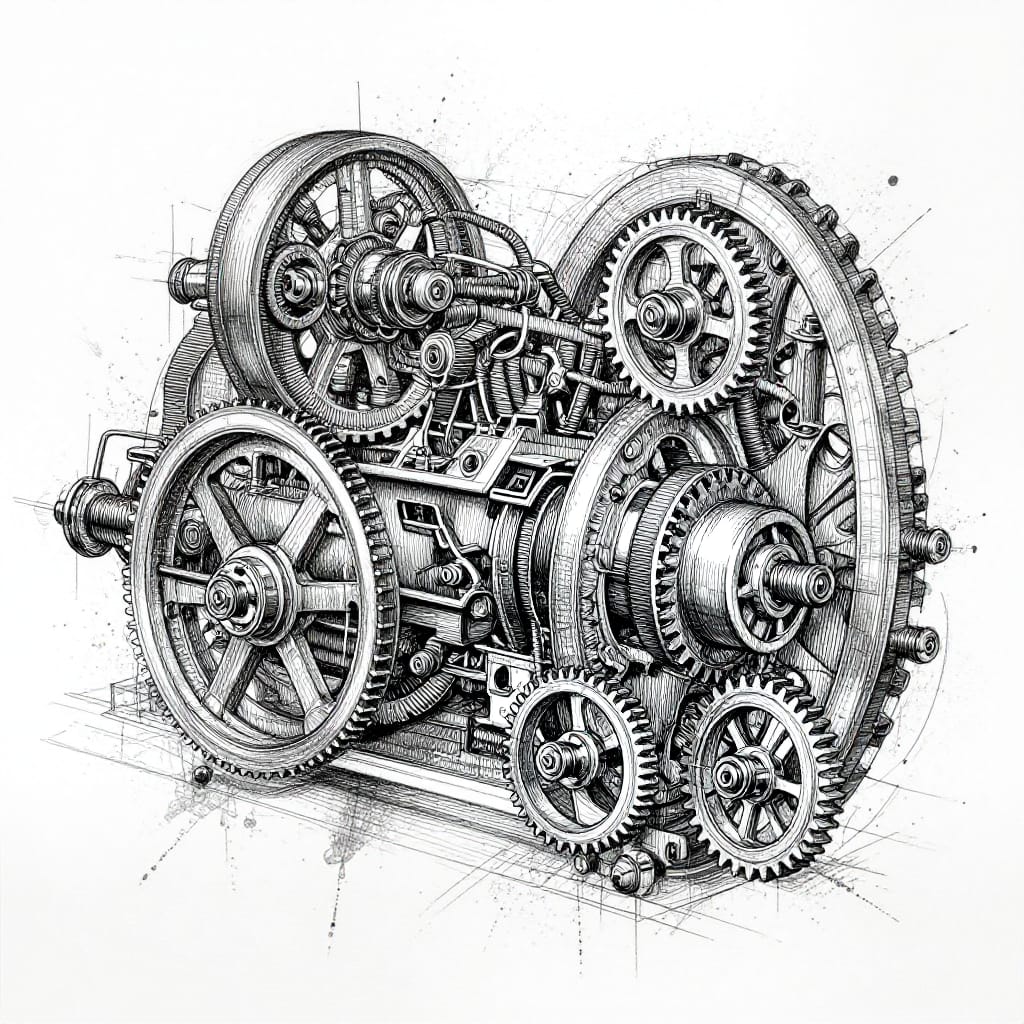
A detailed, intricate mechanical blueprint illustration rendered in fine black ink on textured paper, with deliberate splattered effects that add organic texture to otherwise geometric lines. The design features a complex mechanical component composed of symmetrical, precisely drawn parts—cogs, gears, pistons, and springs—all labeled with concise technical notation in small, clear script. The composition is highly structured and balanced, evoking a sense of engineering mastery. Uniform lighting across the page eliminates shadows, emphasizing the clarity and depth of each line. Splattered ink effects are strategically placed to suggest motion, heat, or wear, adding a subtle layer of mystery to the otherwise technical surface. The color palette is stark black and white, with tonal variation achieved through ink thickness and splatter density. The overall feeling is one of quiet precision and hidden complexity—where every line tells a story of industry, and the splatters hint at unseen forces in motion.

Mechanical Blueprint

A detailed, intricate mechanical blueprint illustration rendered in fine black ink on textured paper, with deliberate splattered effects that add organic texture to otherwise geometric lines. The design features a complex mechanical component composed of symmetrical, precisely drawn parts—cogs, gears, pistons, and springs—all labeled with concise technical notation in small, clear script. The composition is highly structured and balanced, evoking a sense of engineering mastery. Uniform lighting across the page eliminates shadows, emphasizing the clarity and depth of each line. Splattered ink effects are strategically placed to suggest motion, heat, or wear, adding a subtle layer of mystery to the otherwise technical surface. The color palette is stark black and white, with tonal variation achieved through ink thickness and splatter density. The overall feeling is one of quiet precision and hidden complexity—where every line tells a story of industry, and the splatters hint at unseen forces in motion.
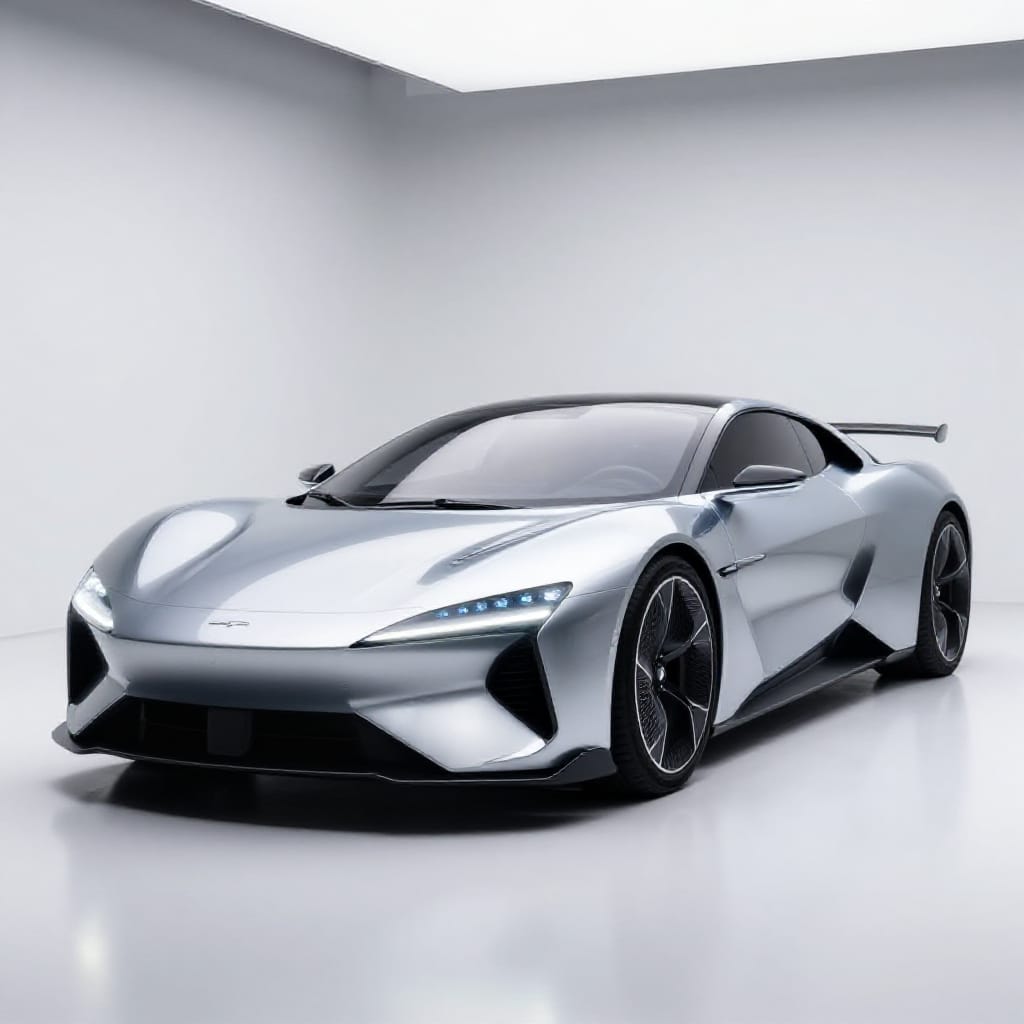
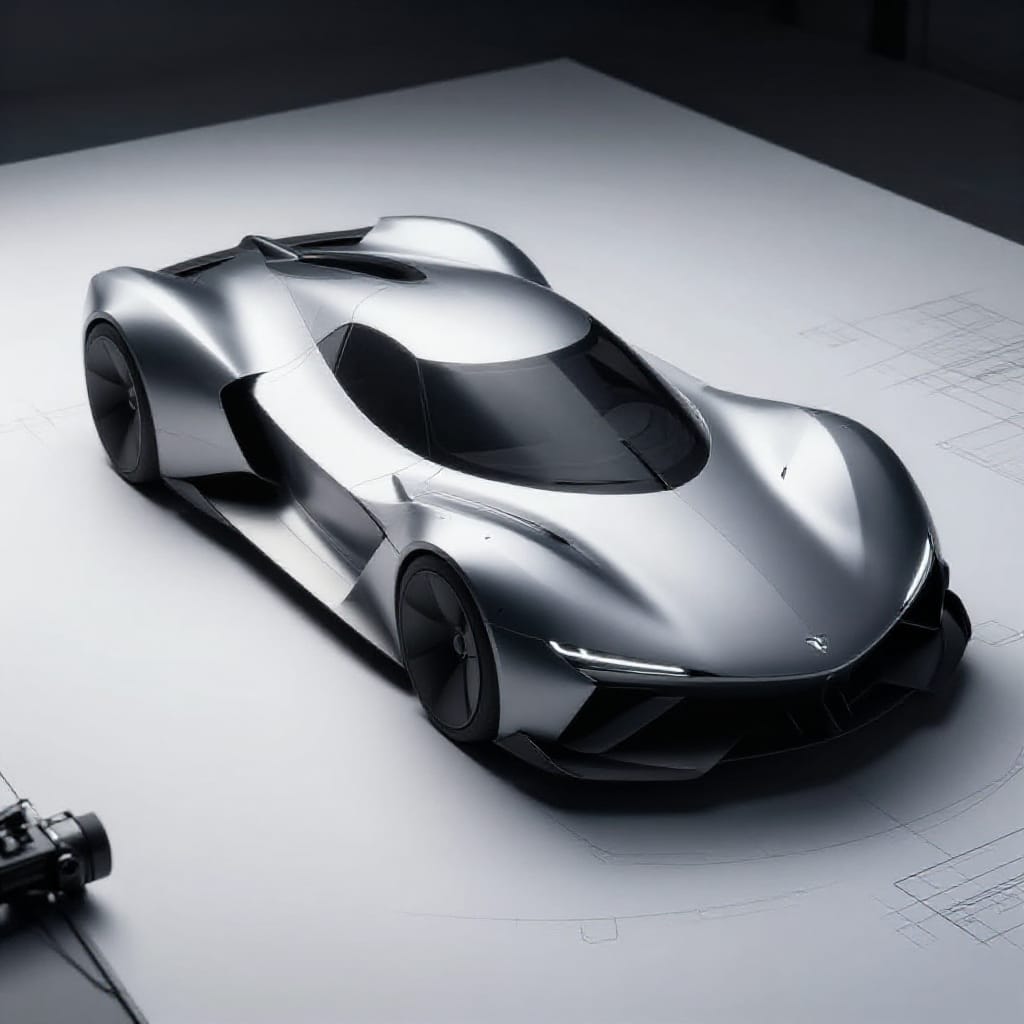
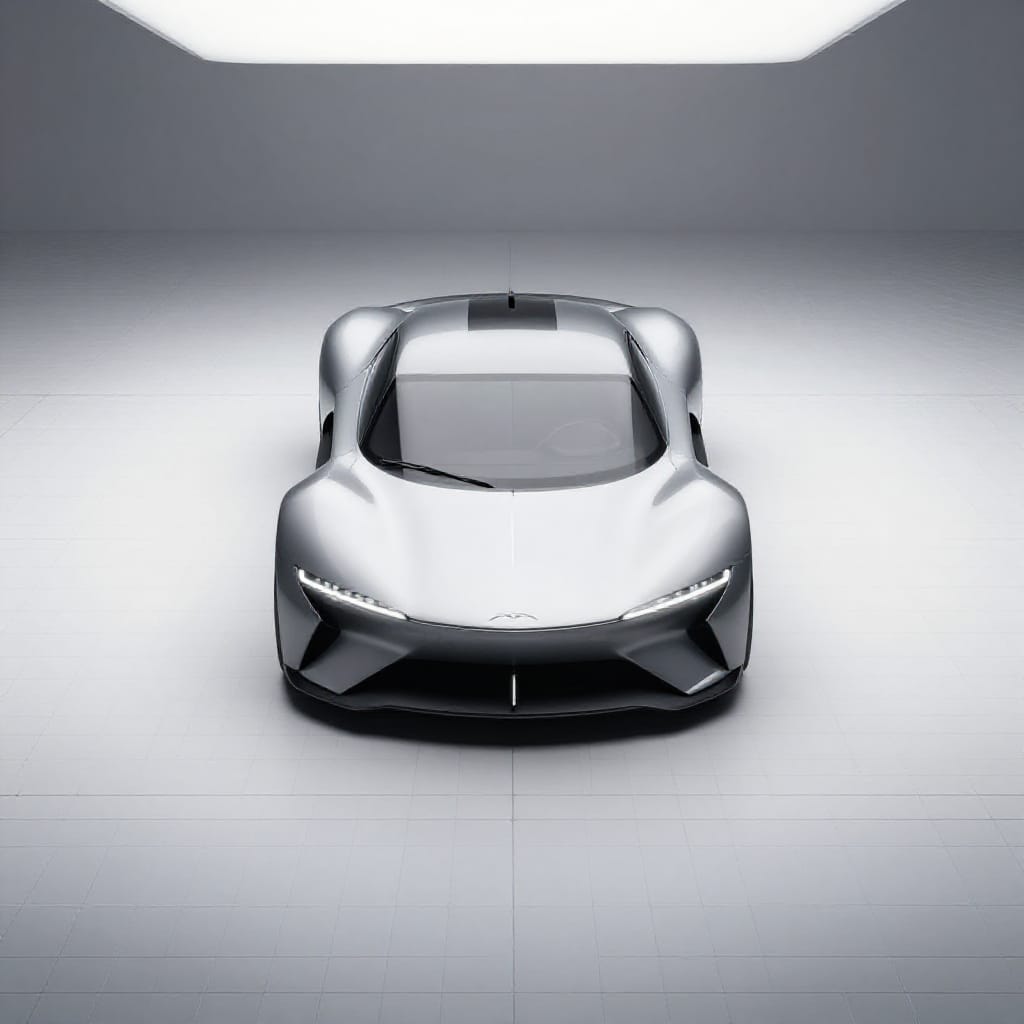
A sleek, modern futuristic car occupies the center of a wide-angle mid-shot frame on a flat testing ground. Rendered in monochrome with precise lines and measurements, the vehicle features a low-profile aerodynamic design, a distinctive front grille, and seamless curves that emphasize its engineering precision. The surrounding grid pattern, composed of evenly spaced lines, suggests a technical or design studio environment, enhancing the sense of symmetry and proportion. An even, bright artificial light source illuminates the scene from above, casting subtle shadows and highlighting the car's detailed surface texture. The atmosphere is clean and focused, with a professional, high-tech ambiance conveyed through the neutral color palette and crisp clarity. The wide-angle lens captures the car in sharp focus while slightly distorting the background grid to emphasize depth. No other objects or figures are present, ensuring the car remains the sole subject of visual attention. The overall feeling is technical and innovative, evoking a sense of cutting-edge design and precision.

Futuristic Monochrome Car

A sleek, modern futuristic car occupies the center of a wide-angle mid-shot frame on a flat testing ground. Rendered in monochrome with precise lines and measurements, the vehicle features a low-profile aerodynamic design, a distinctive front grille, and seamless curves that emphasize its engineering precision. The surrounding grid pattern, composed of evenly spaced lines, suggests a technical or design studio environment, enhancing the sense of symmetry and proportion. An even, bright artificial light source illuminates the scene from above, casting subtle shadows and highlighting the car's detailed surface texture. The atmosphere is clean and focused, with a professional, high-tech ambiance conveyed through the neutral color palette and crisp clarity. The wide-angle lens captures the car in sharp focus while slightly distorting the background grid to emphasize depth. No other objects or figures are present, ensuring the car remains the sole subject of visual attention. The overall feeling is technical and innovative, evoking a sense of cutting-edge design and precision.
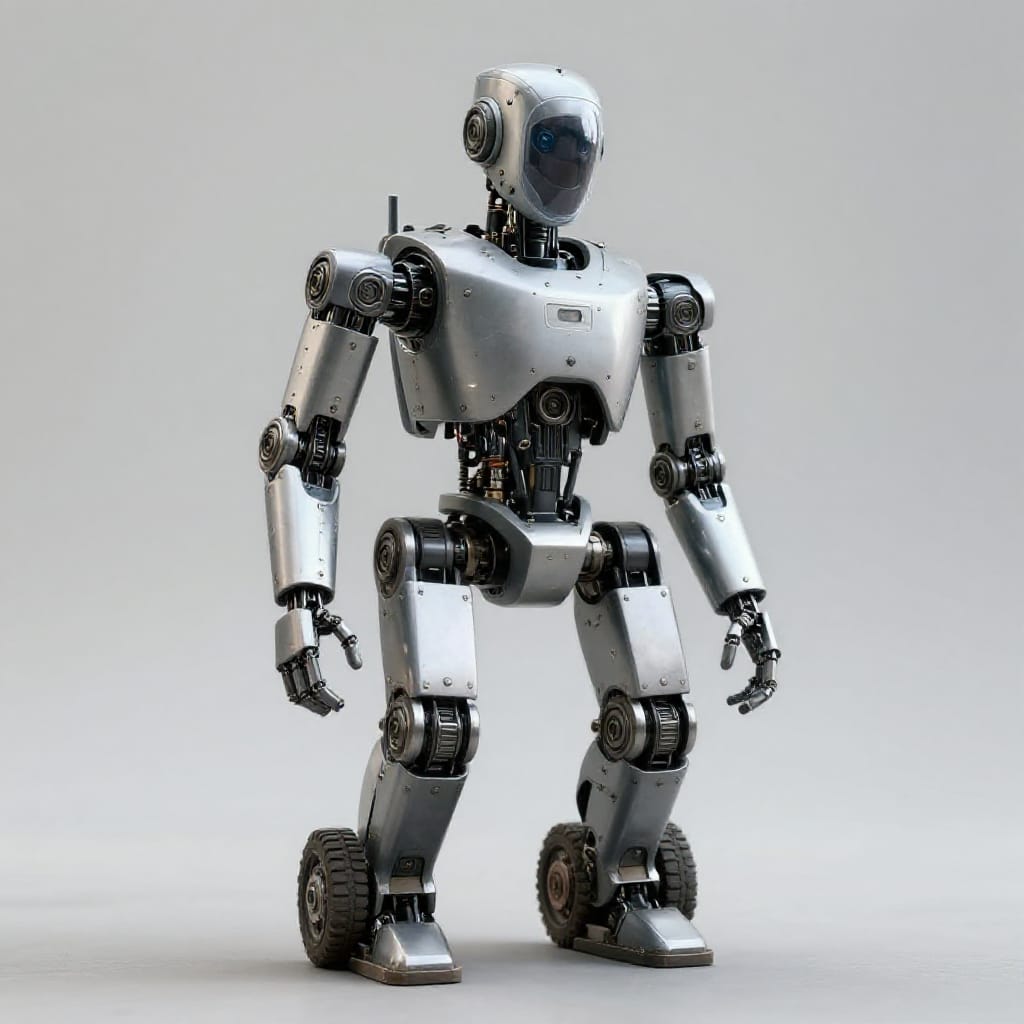
A humanoid robot stands in a mid-shot perspective, centered in the frame with its cylindrical head featuring a clear visor and a mechanical torso displaying precise mechanical joints. Its limbs end in claw-like hands, and at the base of its legs are large, wheel-like components suggesting mobility across varied surfaces. The robot's surface is metallic, detailed with visible rivets and bolts, exhibiting a utilitarian and industrial design with no decorative elements. The environment is minimalist, featuring no discernible background elements, emphasizing the robot as the sole subject. Even lighting suggests a neutral or overcast day, creating consistent illumination across the robot’s form without harsh shadows. The standard lens provides a balanced, natural perspective with moderate depth of field, keeping the robot in sharp focus while slightly softening its surroundings. Motion in the scene is still, indicating the robot is poised or ready to move, capturing a moment of mechanical readiness. The color scheme is neutral, dominated by metallic silver tones with subtle darker accents in joints and wheels, evoking a sense of function over form. The overall atmosphere is industrial, grounded in mechanical precision and practical design, conveying a sense of quiet efficiency and technological purpose.

Mechanical Guardian

A humanoid robot stands in a mid-shot perspective, centered in the frame with its cylindrical head featuring a clear visor and a mechanical torso displaying precise mechanical joints. Its limbs end in claw-like hands, and at the base of its legs are large, wheel-like components suggesting mobility across varied surfaces. The robot's surface is metallic, detailed with visible rivets and bolts, exhibiting a utilitarian and industrial design with no decorative elements. The environment is minimalist, featuring no discernible background elements, emphasizing the robot as the sole subject. Even lighting suggests a neutral or overcast day, creating consistent illumination across the robot’s form without harsh shadows. The standard lens provides a balanced, natural perspective with moderate depth of field, keeping the robot in sharp focus while slightly softening its surroundings. Motion in the scene is still, indicating the robot is poised or ready to move, capturing a moment of mechanical readiness. The color scheme is neutral, dominated by metallic silver tones with subtle darker accents in joints and wheels, evoking a sense of function over form. The overall atmosphere is industrial, grounded in mechanical precision and practical design, conveying a sense of quiet efficiency and technological purpose.
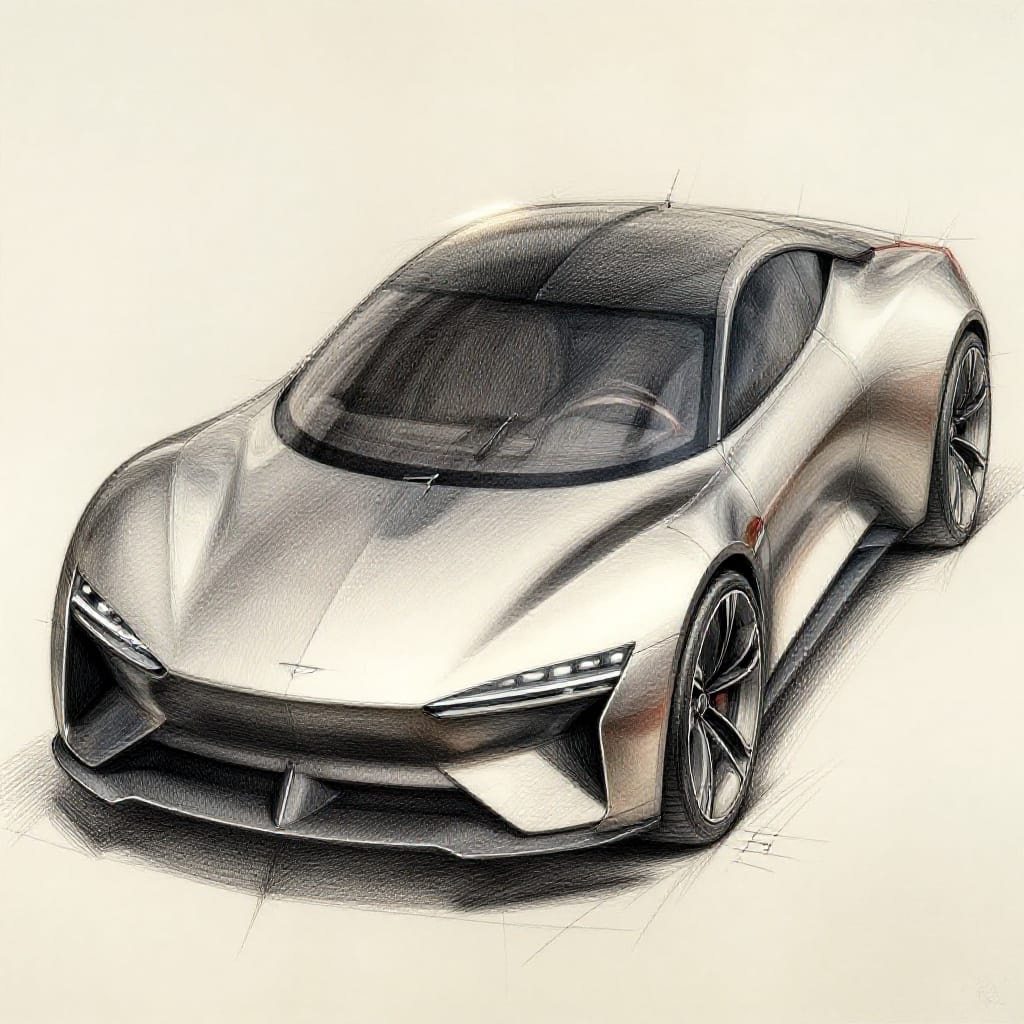
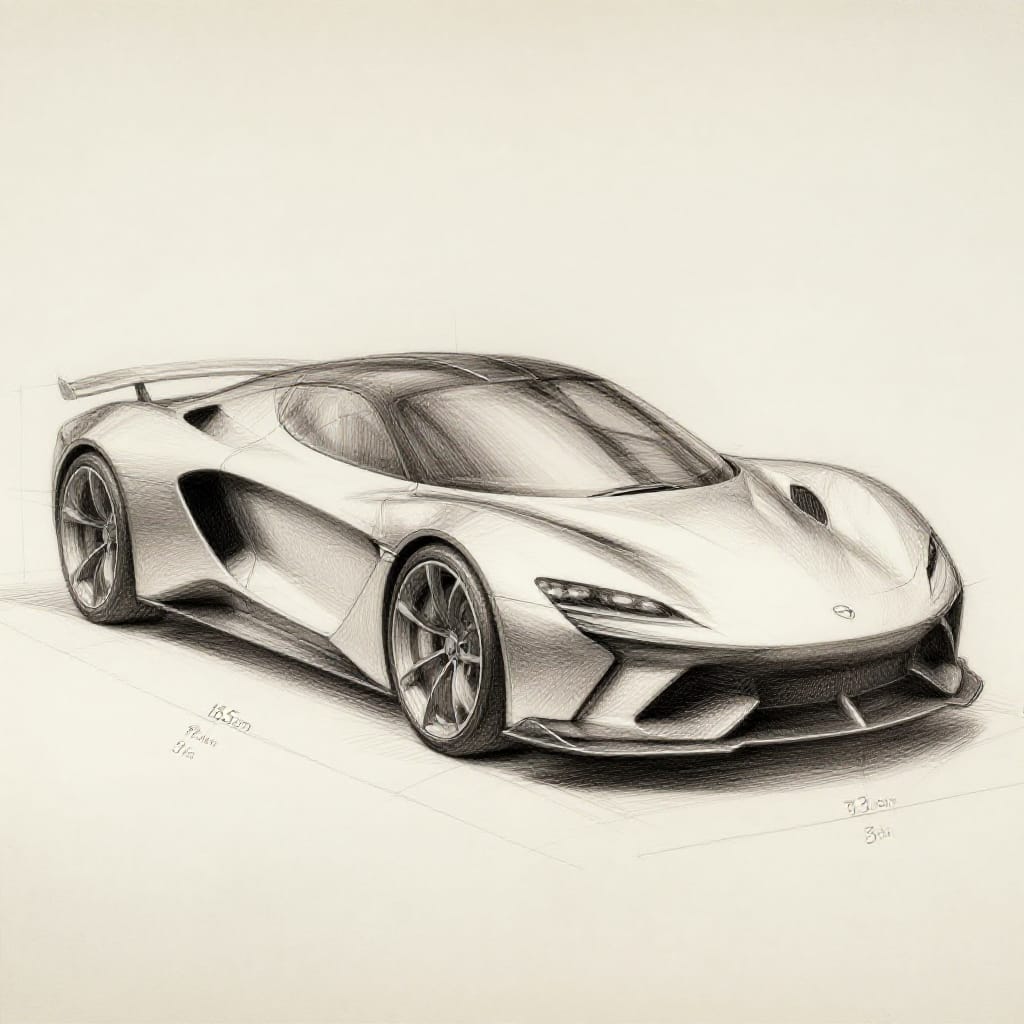
Concept art for a new high-performance sports car rendered in pencil and ink on textured archival paper. The drawing features meticulous technical precision with fine cross-hatching and controlled ink lines capturing every contour of the vehicle's aerodynamic bodywork. A balanced, symmetrical composition centers the car against a soft, muted background of off-white paper with subtle grain texture. Scientific accuracy is emphasized through precise measurements and notations: the vehicle's length is clearly marked at 46.5 inches (118 cm), wheel diameter is specified as 19 inches, and engine displacement is noted as 3.0 liters. The lighting is soft and directional, creating gentle highlights on the hood's curves and subtle shadows beneath the chassis, enhancing depth without flattening the form. The monochrome palette uses varying shades of charcoal, sepia, and gray to define tonal gradients, while the ink strokes exhibit a tactile quality with slight pressure variations visible in the lines. The overall feeling is one of cutting-edge innovation and engineering mastery, evoking a sense of futuristic precision and mechanical elegance.

Precision Car Sketch

Concept art for a new high-performance sports car rendered in pencil and ink on textured archival paper. The drawing features meticulous technical precision with fine cross-hatching and controlled ink lines capturing every contour of the vehicle's aerodynamic bodywork. A balanced, symmetrical composition centers the car against a soft, muted background of off-white paper with subtle grain texture. Scientific accuracy is emphasized through precise measurements and notations: the vehicle's length is clearly marked at 46.5 inches (118 cm), wheel diameter is specified as 19 inches, and engine displacement is noted as 3.0 liters. The lighting is soft and directional, creating gentle highlights on the hood's curves and subtle shadows beneath the chassis, enhancing depth without flattening the form. The monochrome palette uses varying shades of charcoal, sepia, and gray to define tonal gradients, while the ink strokes exhibit a tactile quality with slight pressure variations visible in the lines. The overall feeling is one of cutting-edge innovation and engineering mastery, evoking a sense of futuristic precision and mechanical elegance.
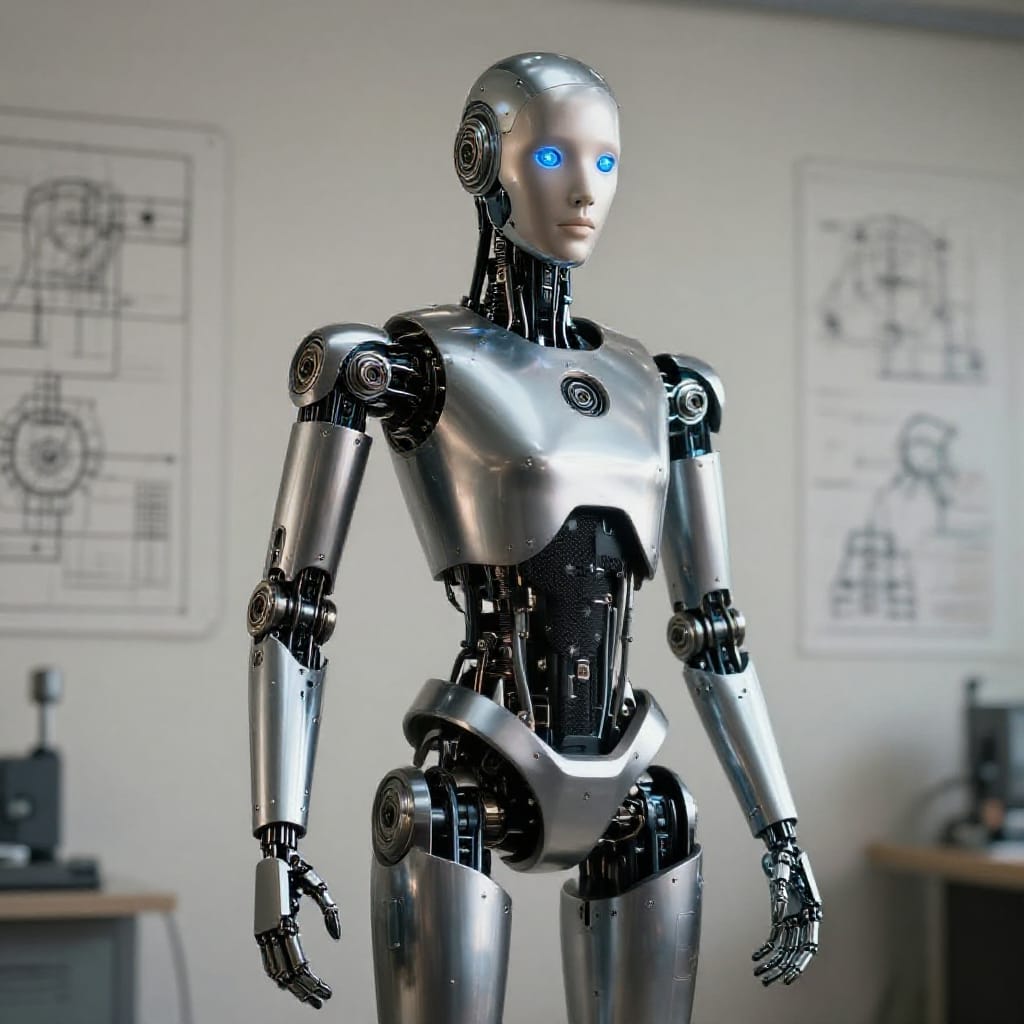
A humanoid robot stands upright in a balanced mid-shot composition, its polished metallic body reflecting soft, even light that casts gentle shadows across its contours. The android's dome-shaped head features a circular visor with glowing blue eyes, suggesting active cognition. Its limbs are constructed from interlocking metal plates and joints, revealing visible screws, rivets, and mechanical components that emphasize its engineered design. The background is a neutral-colored wall adorned with technical schematics and diagrams, reinforcing the industrial setting of a laboratory or workshop. The lighting is soft and natural, diffused from an ambient source that avoids harsh highlights while preserving the metallic sheen. A standard lens captures the scene with minimal distortion, focusing attention on the android's intricate details. The atmosphere is industrial and precise, evoking a sense of technical mastery and focused purpose. The overall feeling is neutral yet grounded in innovation, with a color scheme dominated by metallic grays, silvers, and subtle blue accents that highlight the android's advanced design.

Cyborg Companion

A humanoid robot stands upright in a balanced mid-shot composition, its polished metallic body reflecting soft, even light that casts gentle shadows across its contours. The android's dome-shaped head features a circular visor with glowing blue eyes, suggesting active cognition. Its limbs are constructed from interlocking metal plates and joints, revealing visible screws, rivets, and mechanical components that emphasize its engineered design. The background is a neutral-colored wall adorned with technical schematics and diagrams, reinforcing the industrial setting of a laboratory or workshop. The lighting is soft and natural, diffused from an ambient source that avoids harsh highlights while preserving the metallic sheen. A standard lens captures the scene with minimal distortion, focusing attention on the android's intricate details. The atmosphere is industrial and precise, evoking a sense of technical mastery and focused purpose. The overall feeling is neutral yet grounded in innovation, with a color scheme dominated by metallic grays, silvers, and subtle blue accents that highlight the android's advanced design.
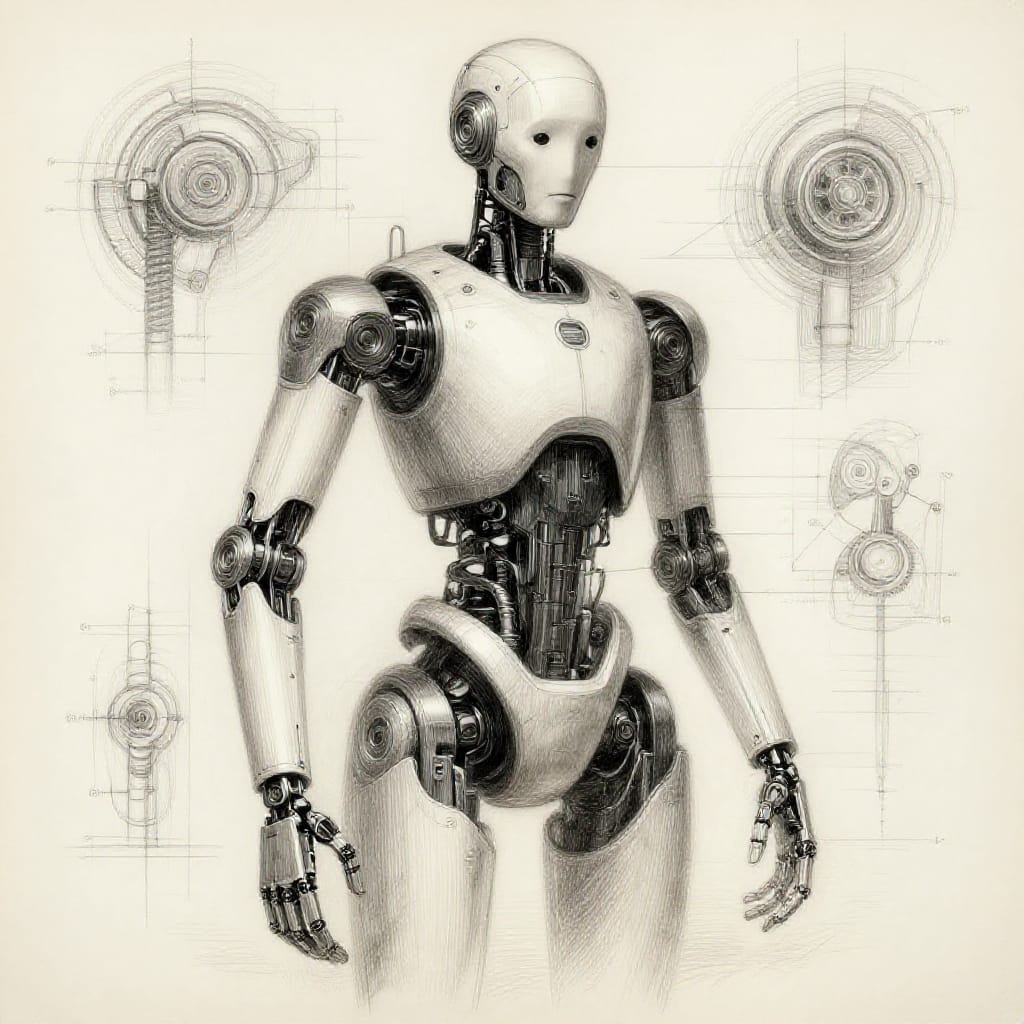
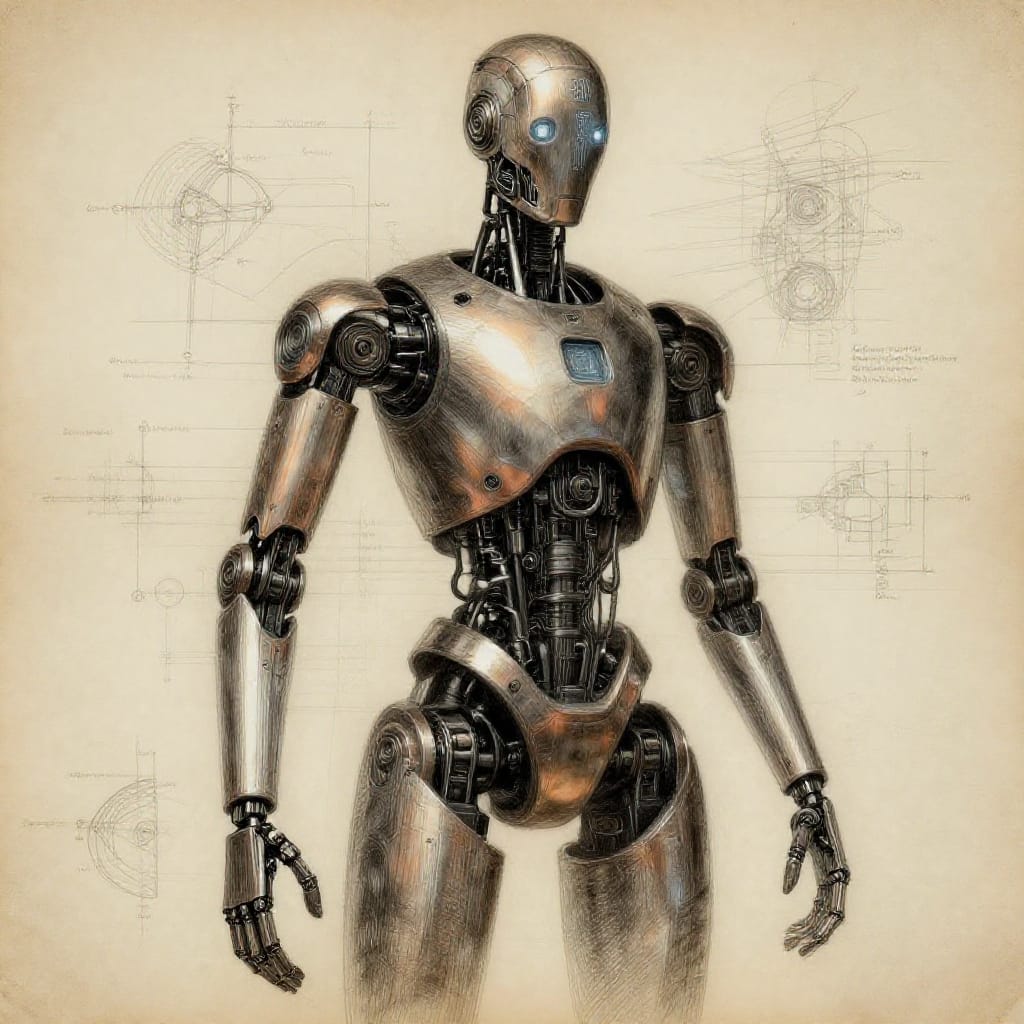
Concept art for a robotic companion rendered in precise pencil and ink on aged paper. The artwork features a humanoid figure with a metallic torso, articulated limbs, and a sleek head with glowing circuit-like eyes. Scientific accuracy is emphasized through detailed anatomical proportions: the robot stands at 1.8 meters tall, with each limb measuring 50 cm in length, and its torso spans 1.2 meters in width. Cross-hatching and fine linework define every surface, including subtle shading on the metallic plating to mimic reflective light. The composition is balanced and symmetrical, with a central focus on the head and chest. Soft, directional lighting from above casts gentle highlights across the curves of the spine and shoulders, while shadows deepen in the crevices of the joints. The color palette is monochromatic, using shades of gray, slate, and bronze to create tonal contrast. Scientific notation is subtly integrated into the design: faintly visible technical diagrams outline the internal mechanical structure, including gears and hydraulic conduits. The aged paper surface exhibits a textured grain, with light imperfections and slight bleed-through enhancing the tactile authenticity. The overall artistic feeling is precise, futuristic, and deeply technical, capturing both the mechanical elegance and human-like presence of the companion.

Robotic Companion Concept

Concept art for a robotic companion rendered in precise pencil and ink on aged paper. The artwork features a humanoid figure with a metallic torso, articulated limbs, and a sleek head with glowing circuit-like eyes. Scientific accuracy is emphasized through detailed anatomical proportions: the robot stands at 1.8 meters tall, with each limb measuring 50 cm in length, and its torso spans 1.2 meters in width. Cross-hatching and fine linework define every surface, including subtle shading on the metallic plating to mimic reflective light. The composition is balanced and symmetrical, with a central focus on the head and chest. Soft, directional lighting from above casts gentle highlights across the curves of the spine and shoulders, while shadows deepen in the crevices of the joints. The color palette is monochromatic, using shades of gray, slate, and bronze to create tonal contrast. Scientific notation is subtly integrated into the design: faintly visible technical diagrams outline the internal mechanical structure, including gears and hydraulic conduits. The aged paper surface exhibits a textured grain, with light imperfections and slight bleed-through enhancing the tactile authenticity. The overall artistic feeling is precise, futuristic, and deeply technical, capturing both the mechanical elegance and human-like presence of the companion.
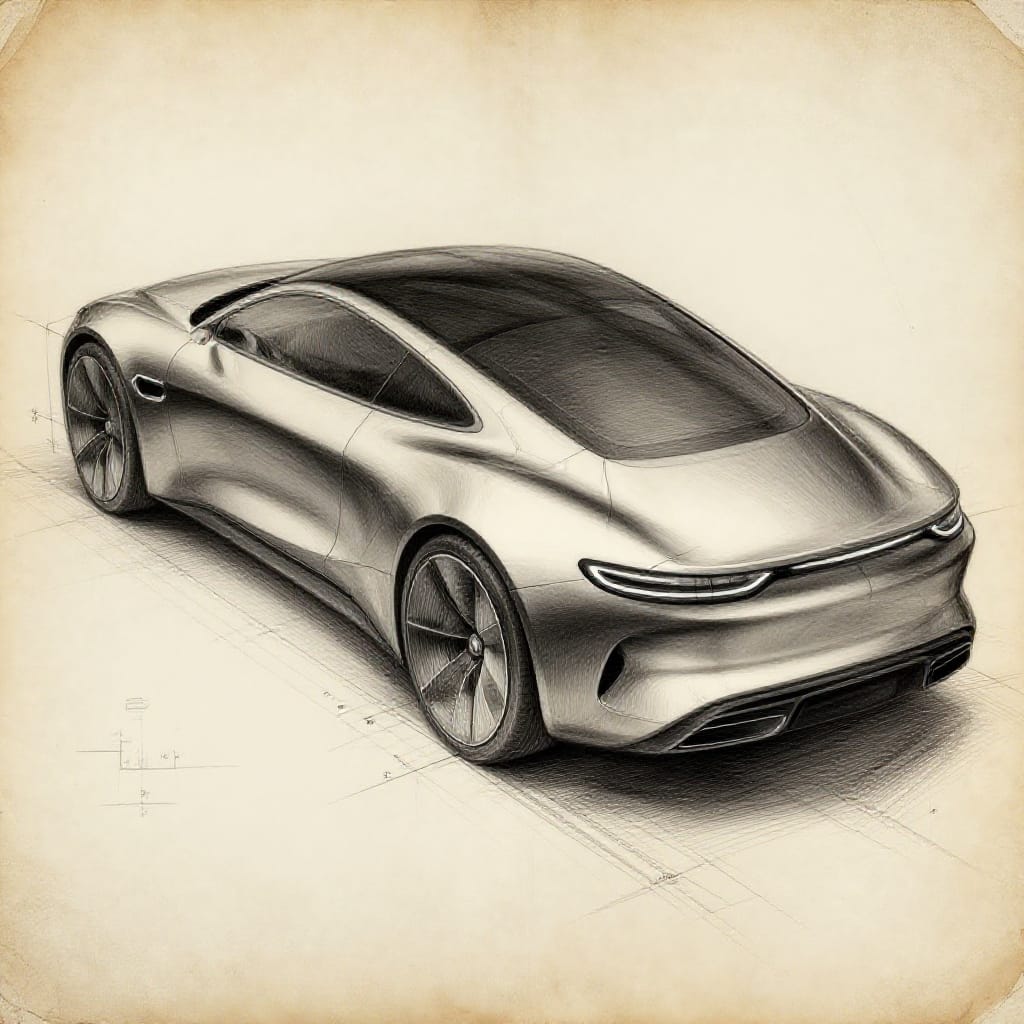
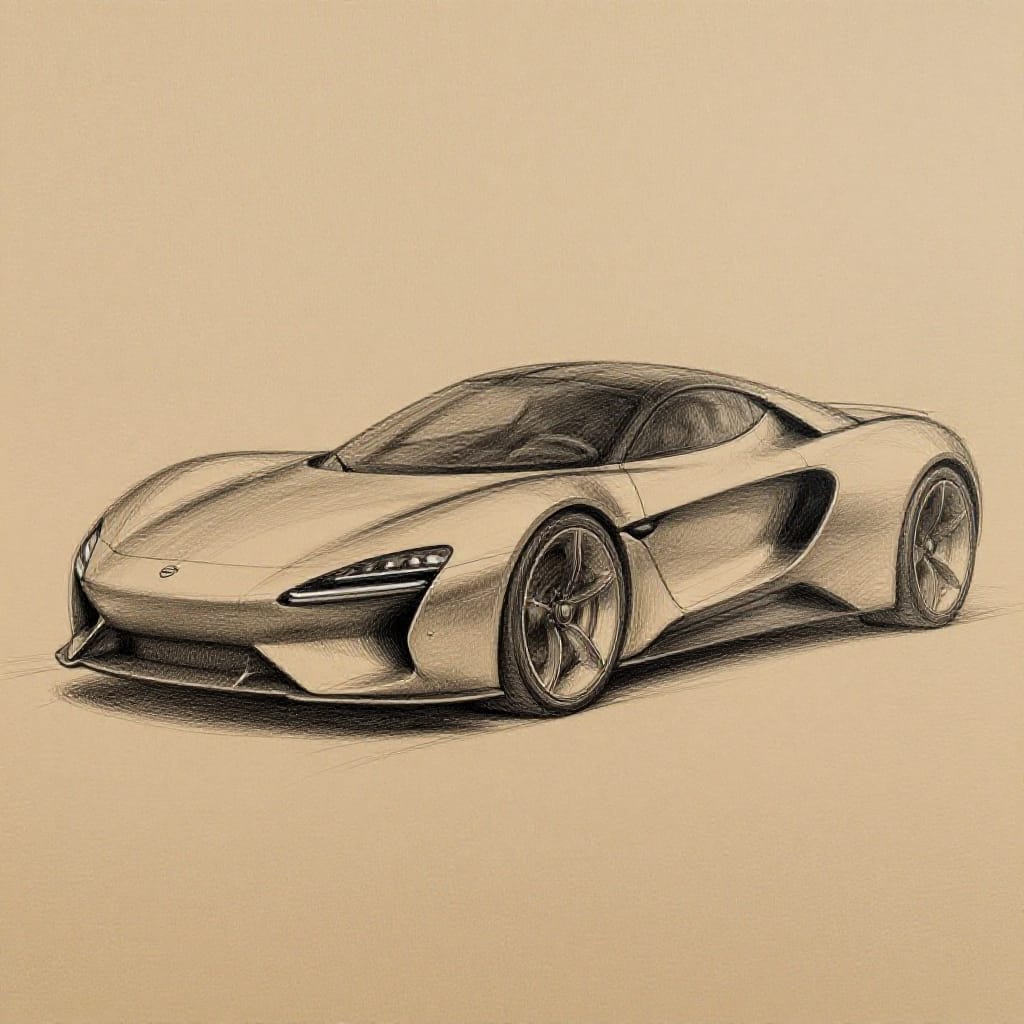
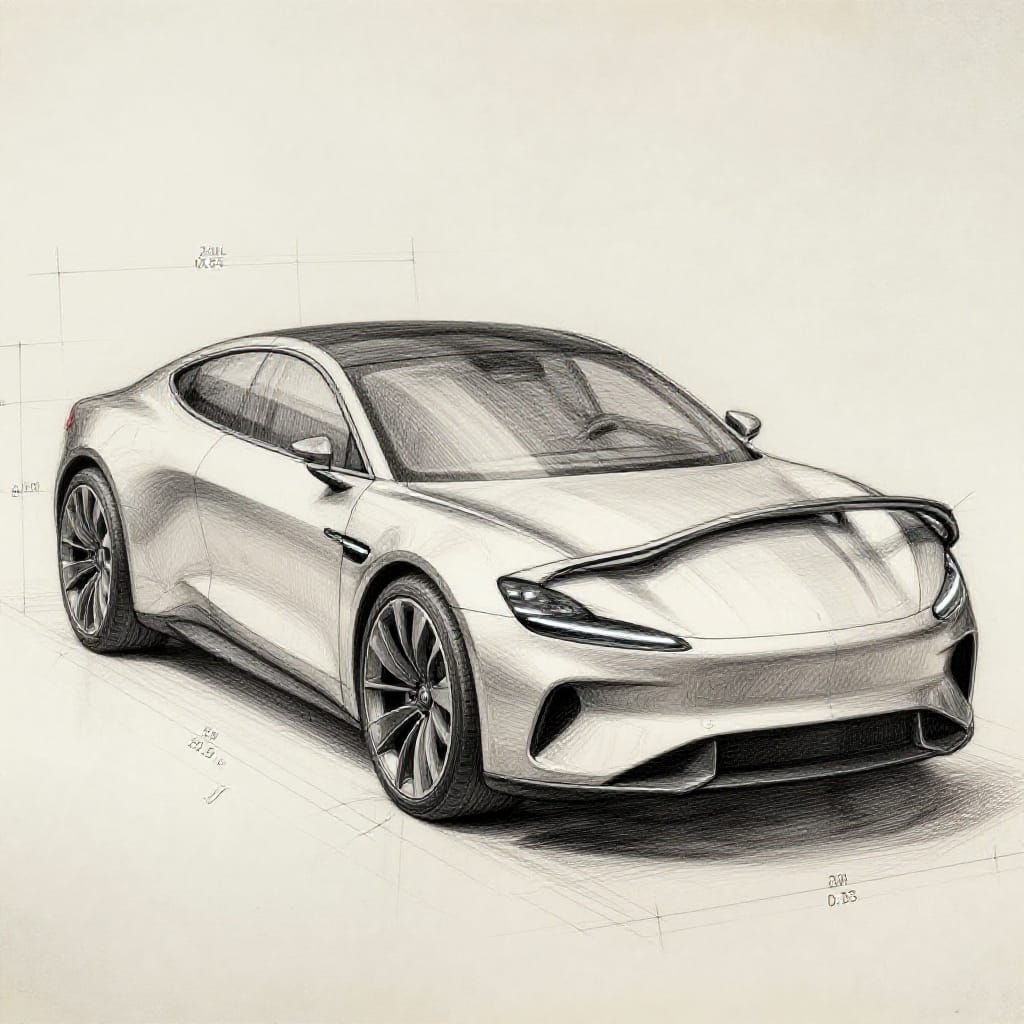
Concept art for a futuristic luxury sedan rendered in meticulous pencil and ink on aged, textured paper. The composition features a sleek, aerodynamic vehicle with precise engineering details: a low-profile hood, integrated LED taillights, and a dual-tone body panel with subtle gradient shading. Scientific accuracy is emphasized through precise measurements marked in millimeters along the chassis and wheelbase, while cross-hatching and fine linework define every curve and surface texture. The lighting is soft and directional, casting gentle shadows that highlight the car's curves and metallic sheen. A detailed technical illustration includes scale indicators, part numbers, and cross-sectional views of the suspension system. The aged paper adds a tactile depth with visible grain, minor water stains, and faint pencil marks at the edges, enhancing the vintage authenticity. The monochrome palette uses subtle tonal variations to create depth without color, focusing on contrast and form. The overall feeling is one of innovative precision and timeless design, capturing both the functional elegance and advanced technology of the vehicle.

Futuristic Aged Sketch

Concept art for a futuristic luxury sedan rendered in meticulous pencil and ink on aged, textured paper. The composition features a sleek, aerodynamic vehicle with precise engineering details: a low-profile hood, integrated LED taillights, and a dual-tone body panel with subtle gradient shading. Scientific accuracy is emphasized through precise measurements marked in millimeters along the chassis and wheelbase, while cross-hatching and fine linework define every curve and surface texture. The lighting is soft and directional, casting gentle shadows that highlight the car's curves and metallic sheen. A detailed technical illustration includes scale indicators, part numbers, and cross-sectional views of the suspension system. The aged paper adds a tactile depth with visible grain, minor water stains, and faint pencil marks at the edges, enhancing the vintage authenticity. The monochrome palette uses subtle tonal variations to create depth without color, focusing on contrast and form. The overall feeling is one of innovative precision and timeless design, capturing both the functional elegance and advanced technology of the vehicle.